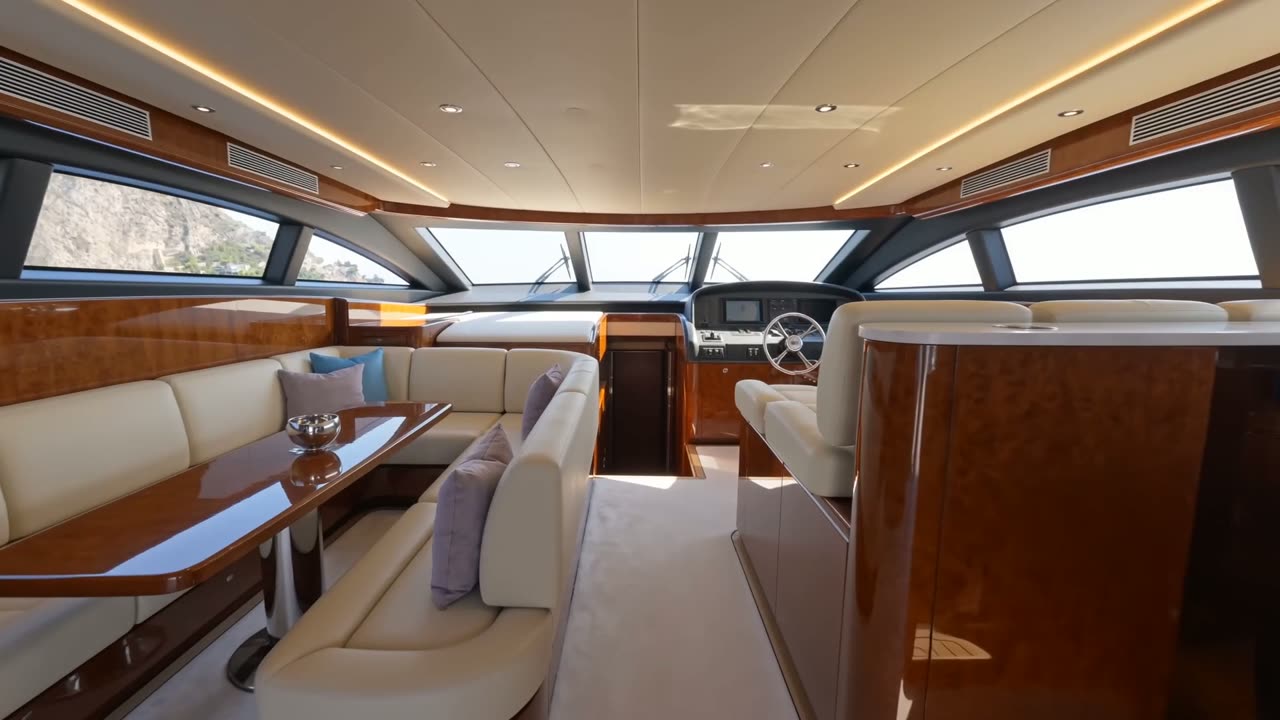
The problem with most property films is that the people making them have only watched other property films. A visual language cannot evolve inside a closed loop, and the estate-agent video, as a form, has been in one for twenty years. The way out is to look elsewhere.
What follows is a short list of films — none of them about real estate — that shaped the way Parallax thinks about the subject. If a marketing director at a prime agency watched all of them in a weekend, the next film they commissioned would be measurably better.
Fashion
The visual language most closely related to luxury property is not architectural photography. It is the fashion film. Both are selling atmosphere more than object. Both use light and pacing rather than description. Both understand that the viewer needs to project themselves into the frame.
Somewhere, Sofia Coppola, 2010, is not a fashion film in the ordinary sense, but its interiors work exactly like ones. Empty hotel corridors, a Ferrari parked in a driveway, a swimming pool at night. The film teaches a specific lesson: a space becomes desirable when a camera holds still in it for slightly longer than expected.
The Prada campaign films from the mid-2010s — Castello Cavalcanti by Wes Anderson, A Therapy by Roman Polanski — are worth watching for how quickly a world can be established. Ninety seconds, one location, a complete atmosphere. Property films at the top of the market should aspire to that economy.
Architecture
The architectural documentary is where the discipline of showing a building well was refined. It is a different job from selling one, but the visual vocabulary transfers.
Rem Koolhaas: A Kind of Architect, Markus Heidingsfelder and Min Tesch, 2008, is the reference film for showing a building without decoration. The camera moves slowly. The buildings are shown at different times of day. There is no music covering silence. A property film that borrows even ten percent of this discipline reads as more serious than its peers.
Cathedrals of Culture, produced by Wim Wenders, 2014, is a set of short films each shot inside a single building. The Berlin Philharmonic. The Salk Institute. Halden Prison. The films are relentless about one idea: a building has a temperament, and the camera's job is to find it. Every drawing room in a Chelsea townhouse has a temperament too. Most property films miss it because they never sit still long enough.
Documentary
The best documentary interior cinematography sits on the ordinary and finds it beautiful. That is exactly the skill a property film needs. A luxury drawing room is not visually harder to shoot than a shipbuilder's kitchen in Le Havre. The problem is that the property filmmaker treats the drawing room as inherently interesting, and stops working.
Nostalgia for the Light, Patricio Guzmán, 2010, is worth studying for how the camera handles space at scale. The Atacama Desert stands in for anything vast — a garden at Cliveden, the atrium of a Mayfair penthouse, the aft deck of a superyacht. The lesson is the same: scale needs a foreground, or the eye has nothing to read against.
Restraint
The film every property marketer should watch, at least once a year, is Man on Wire, James Marsh, 2008. Not for its aesthetics — it is a fairly ordinary looking film — but for its ruthlessness with time. Nothing is on screen for longer than it needs to be. Nothing is decorative.
The single most common flaw in property films at every price point is that they are too long. A four-minute film of a townhouse tells a buyer that the marketer did not know which forty seconds mattered. Watching a film that never wastes a shot is the fastest way to develop that instinct.
What this list is not
It is not a taste primer. Taste is downstream of watching, and every marketer will draw different lessons from the same films. What the list is trying to prevent is the closed loop — the property filmmaker who watches other property films, notices the same three moves being used everywhere, and reproduces them without knowing why.
The films above are not the answer. They are a way out of the loop. What comes after them is your own eye, which is what the market is actually paying for.